Neurobiology of Autism (Dr. Martha Burns, PhD, CCC-SLP)
I had the opportunity to listen to a recorded presentation “Neurobiology of Autism: Interventions that Work by Dr. Martha Burns, PhD, CCC-SLP on current research in the field of neurobiology of Autism. The original presentation was delivered in November 2013. Dr. Burns is one of the leading researchers in this field. The purpose of the presentation was to summarize the new research in the area of neurobiology as it pertains to children on the Autism Spectrum. The reason I was intrigued was because it explained autism in a way that, for me, finally made sense. Not only did it explain (in theory at least) why children on the autism spectrum demonstrate the characteristics that they do, but also why almost every autistic child presents differently from the others. The purpose of this blog isn’t to recreate Dr. Burns’ presentation, but to quickly highlight the salient points for parents and other professionals. However, I highly recommend listening to the actual presentation since there were so many details embedded within it that are beyond the scope of this blog.
The presentation was broadly divided into three major sections:
- Etiology of autism- In summary, Dr. Burns narrows the causes of autism to genetic mutations (age of parents, environmental factors causing mutations in the fetus) and neurotoxicology (certain antibodies in the mother may enter the amniotic fluid and these can cause autism). In essence, Dr. Burns refutes theories that suggest that diet and immunizations may be possible causes of autism.
- Neurobiology of Autism- This portion of the presentation discussed the use of “Diffusion Tensor Imaging” (an imaging technique that is more sophisticated than MRI scans). Using this technology, researchers were able to map white matter fiber tracts. These fiber tracts develop in individuals from the 3rd trimester until about 30 years of age. These are long fibers tracts that run across multiple lobes of the brain. Some of these fiber tracts in the left hemisphere of the brain impact speech development and auditory processing. Because these fibers are long, they are particularly vulnerable. According to Wass (2011), autism is a disorder of long white matter fiber tract development. A study by Wolf, et. al. (2012) also surmised that there was aberrant development of white matter fiber tracts in children with autism spectrum disorder. They also found that the fiber tracts in infants up to about 6 months of age are similar in typical children and children on the autism spectrum. After 6 months of age, they noticed a blunted development in these longitudinal fiber tracts in children with autism. This explains why often parents report that their children appeared typically developing in infancy and the autism-like symptoms were not present until later. Researchers have also found that the development of these fiber tracts is different among children with autism. Hence we see a great diversity in skills, abilities and deficits in children on the autism spectrum. In addition, since the longitudinal (long) fiber tracts are insufficiently developed, the short tracts that are overused. This results in an increase in repetitive and stereotypical behaviors, so frequently seen in children on the autism spectrum. Just as the white matter fiber tracts in the left hemisphere of the brain impact speech and language development, fiber tracts in the right hemisphere impact social skills and pragmatics (Stanley & Adolph, 2013).
- Interventions that may prove to be beneficial- So the most crucially, how do the above findings about the neurobiology of autism impact interventions? In a crux, according to Dr. Burns, therapies that drive longitudinal white matter tract development are beneficial. Because the theory of neuroplasticity is well documented, well-designed therapy programs based on neuroscience are effective. It now appears that the combination of computerized interventions such as Fast ForWord® and individualized clinical approaches hold the greatest promise. Dr. Burns also discussed the three levels of processing:
High Level —- Complex Problem Solving
Mid Level —- Grammar and Vocabulary
Low Level —- Perceptual Skills
Researchers believe that it is the low level processing (perceptual skills) that drives the white matter tracts. These perceptual skills can be impacted effectively through computerized programs such as Fast ForWord®. However, it important to note that perceptual skills should not be addressed in isolation. The most effective interventions should therefore include computerized approaches that drive neuroplasticity and behavior interventions for functional limitations.
While new research that explains Autism is enlightening, what is truly exciting for me, is the knowledge that we can now tailor interventions and treatment programs so that they are truly effective.
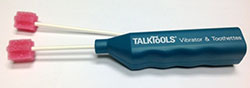 Once Sam’s tactile defensiveness was significantly reduced, my next goal was to stabilize his jaw and increase jaw grading (i.e. opening and closing of his mouth to various jaw heights without jaw sliding or jerking). Since Sam tended to “fix” his jaw at jaw height 1 (closed mouth position) during speech, my objective was to move him gradually through Sara R. Johnson’s Bite Block hierarchy. Unless Sam was able to lower his jaw to jaw height 3 or 4, production of vowels such as /Ɔ/ would be challenging. We started with Bite Block #2 and within several weeks were able to move to Bite Block #6, which requires considerable jaw opening. Sam can now hold a lower jaw position without sliding. As a part of a comprehensive oral motor or oral placement program, we also worked on lip rounding, lip seal and tongue retraction. Sara R. Johnson’s Horn and Straw Hierarchy’s were employed for this purpose. In addition, a tongue depressor with added “weights” (pennies taped to both ends) were used to build lip strength and lip closure.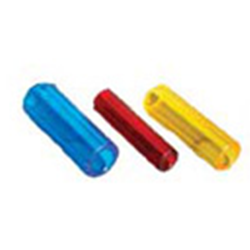

 After 11 years in the field, I finally came across a curriculum that made teaching emotions a fun and positive learning experience. I was fortunate enough to be able to attend a presentation by Diann Grimm, M.A., CCC-SLP, Ed. S. on the Kimochi Curriculum. Kimochis in Japanese mean feelings. The program incorporates Kimochi characters with a pocket to place their Kimochis (emotions). Each Kimochi is a soft pillow with the feelings printed on one side and the corresponding facial expression on the other side. Using the Kimochis in conjunction with the feelings lessons as a part of the curriculum allows the children to learn to identify and express their emotions in a safe and focused manner. It fosters Social-Emotional Learning (SEL) which is a critical adjunct to the Social Thinking ® curriculum proposed by Michelle Garcia Winner. The adorable toys and the fun and child-friendly curriculum is a great way to support positive behavior, self awareness, social awareness, self management, relationship skills and decision making. It appears that some of the early research using this curriculum has shown positive results for children with Social-Emotional Learning difficulties (e.g. children on the Autism Spectrum). In addition, this curriculum has also been used for typical children in general education classrooms. I am so pleased and excited to offer the Kimochi Curriculum as a part of the Social Thinking groups. I think it will be an important piece to the puzzle that addresses the “Feelings-Communication-Behavior link” that Diann Grimm talks about.