Just as we started opening up Amelie’s vocabulary on Speak for Yourself, her parents requested a training session at home. They wanted to make sure they were doing everything they could at home to incorporate her communication system. (For all of you who are wondering; yes this family is truly that awesome!) It was a unique opportunity. Most speech therapists (myself included) define our success by our client’s progress. But sometimes (especially for AAC), success should be measured by a caregiver’s motivation and ability to incorporate the AAC system in all arenas of the child’s life.
The training was scheduled during Amelie’s naptime. Amelie’s parents and her nanny were present. I prepared for the training session by putting together questions and concerns. I listed them below hoping that they may be useful for other therapists and families.
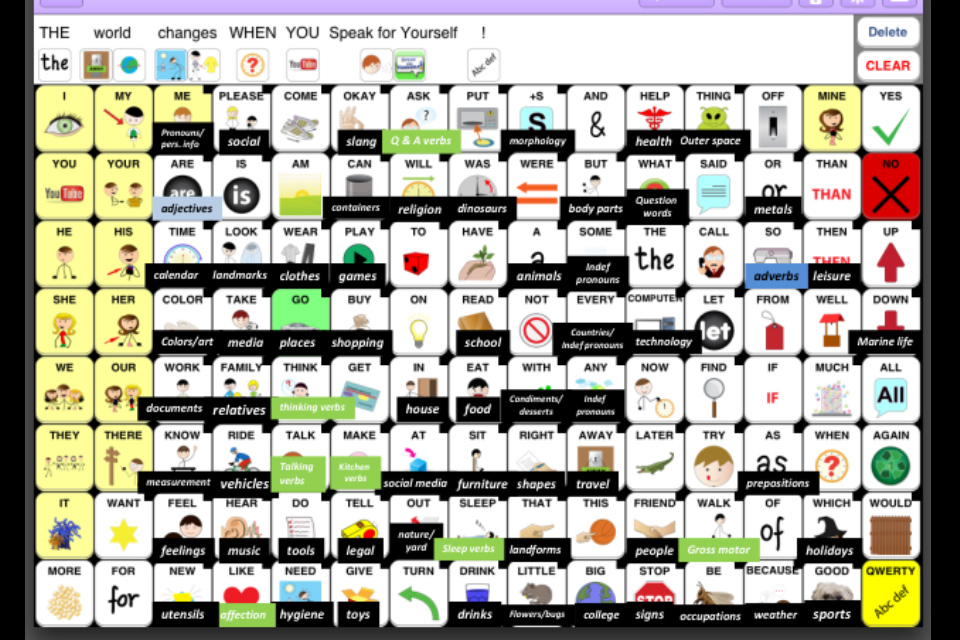
Categories for Speak for Yourself App
- How soon should we leave a word “open” on SfY?
As I understand it, a child has to use a word consistently (about 3-4 times) for it to be considered a part of her vocabulary. It should then be left open as a part of her vocabulary. Think of it this way: when a child learns to say a word, she can access it anytime she wants. We don’t take it away and give it to her only when we want her to say it. I would look at teaching words in the SfY the same way. For Amelie we did deviate slightly for a session to work on discrimination as described in the blog “A Voice for Amelie Part 2: Ready to Choose.” As a therapist or parent, you know your client’s or child’s learning patterns and as such you are the best judge of how quickly you can open up words on the SfY. But the important thing to remember is to allow a child to access his/her vocabulary as soon as possible. Assuming that having multiple buttons open at once may overwhelm the child, is at best presumptuous and undermines a child’s true potential. - What’s more important, errorless learning or using the device independently?
My opinion is that independence is more important than always picking the right word correctly. So decreasing the amount of physical prompts as quickly as possible is recommended. Maybe model once or provide a physical prompt once and then step back to see what she can do. Self-corrections are a great way to learn. Think about how typical children learn language. They have errors in articulation and grammar too. If your child/ client has trouble self-correcting, or is looking at you for help, go ahead and model again. The point to remember is that using physical prompts excessively 1) assumes you know what the child wants and, 2) will reduce the opportunities for a child fix a communication breakdown by self correcting. - How often and when should my child/ client have access to her communication system?
Again, think about how often and when a typical child has access to her voice and her words. That’s right…all the time and everywhere. If “Speak for Yourself” is your child/ client’s voice and communication system, it should really be accessible as often as possible. Even if she doesn’t have the words open that seem appropriate for the situation, she should still have the iPad accessible. How great would it be if it were a natural response for her to reach for the iPad when she wants to comment on something, or ask for something? We can always open or program words for her when appropriate. But the goal for now is to hammer in the idea that this app is (at least for now) her voice and her communication system. - Besides making requests, how can we incorporate SfY in our daily lives?
Using the app to model language everyday is key. It will take some getting used-to. The primary mode of learning for any child is imitation. So the more you model using the app, the more she will use it. While it may be really overwhelming to imagine using the app for every conversation, maybe make a list of daily routines during which you can use SfY. For example:
– Greetings (e.g., Hi Mommy, Bye Sonali)
– Diaper changes (e.g., Change diaper)
– Bath time (wash)
– Getting dressed (Want dress)
– Getting into the car (e.g., Go out, Go in car)
– Going to the park (More swing)
– Nap time (Wear pajamas)
– Talk about something unexpected that may happen (e.g., go beach)
– Use it with a friend, neighbor, or extended family (e.g., Hi, How are you?) - Should my client/child have time to play and babble with SfY?
Yes! As often and for as long as possible during the day.
Other important points to remember:
* If you don’t model using SfY for more than just making requests, she won’t know how to use it for more than just making requests.
** When modeling, think about your goals. If you are targeting 2-3 word utterances, that’s what you want to model.
*** When modeling, you are showing her how to talk using SfY. She isn’t necessarily expected to imitate right away. If she does, that’s great, but if she doesn’t, it doesn’t mean that she isn’t learning. When we model language to a young child, we don’t expect her to imitate the whole sentence right away. She may imitate just a key word, or not say anything at all. She’s still learning.
 I have been exposed to the Fast ForWord® program for several years. I was introduced to the program during my Clinical Fellowship (first year of work after grad school). I worked at a private practice in Pasadena, CA. The owner of the private practice was a veteran in implementing the program and used it with a wide variety of students with disabilities ranging from mild auditory processing to severe autism. My first reaction on viewing the program was skepticism. How can any computer program take the place of a real, live clinician? How can sitting in front of a computer for an hour a day fix all the language and learning problems? Now, 12 years later, as an owner of a private practice and a Fast ForWord provider, my perspective hasn’t really changed. Fast ForWord cannot (and wasn’t designed to) take the place of a therapist, nor can it truly “fix” all language and learning challenges. So perhaps, it is more productive to look at what it was really meant to do, and then decide if it truly does work.
 Are you having trouble squeezing in time to develop novel therapy materials for your social thinking groups? You’re not alone. With a crazy schedule of both private and public school speech therapists, this new pack of cards is an incredible time-saver.
 Severe Apraxia of Speech and a seizure disorder, I attempted the “Sign to Talk” program (Tamara Kasper, M.S., CCC-SLP, BCBA; Nancy Kaufman, M.A., CCC-SLP). The program is offered as a “bridge to vocal communication for children that are not yet vocal imitators.” The program consists of two sets of flashcards and instruction manuals. The flashcards are pictures of the object or verb on one side and on the back they have the picture of the sign for the word. On the back, each card also displays a series of ”successive approximations” of the target word based on least physiological effort, as proposed by Nancy Kaufman.